Why native advertising on Taboola and MGID in 2026, for brands that need scale beyond search and social
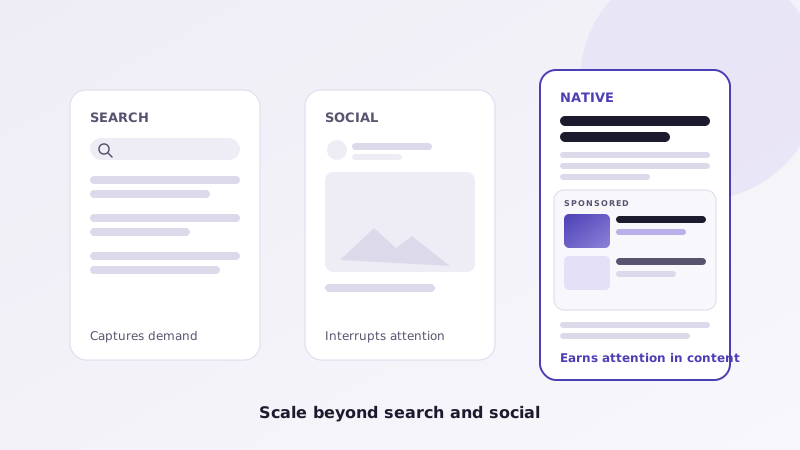
Most growth plans hit the same wall. Branded search is maxed out, non-branded search is expensive and crowded, and social costs climb while the same audiences see the same ads. Native advertising on Taboola and MGID is the channel many US brands turn to at that point. This article explains where native wins, where it does not and what it asks of a brand that wants it to work.
The ceiling on search and social
Search advertising is the best channel ever built for capturing demand that already exists. Its limitation is the same thing that makes it great: it can only reach people who are already typing your category into a search box. Once a brand owns its branded terms and bids on the obvious non-branded ones, the next increment of volume comes at a sharply higher cost per click, because every competitor is in the same auction.
Social advertising solved the reach problem but created another. Feeds are saturated, attention is short and creative burns out in days. For many businesses, the audiences that convert on social are well defined and finite, and pushing budget past them produces impressions, not customers. Costs per thousand impressions have risen steadily, and privacy changes have made measurement less precise.
Native advertising is a different pool of attention. It reaches people while they read articles on news, lifestyle, finance, sports and local publisher sites, in the recommendation feed at the end of a story and in mid-article widgets. Search cannot reach these readers because they are not searching, and social does not reach them because they are reading.
What native advertising actually is in 2026
Taboola and MGID are the two networks we run, and together they cover a wide range of US publisher inventory. Taboola Ads places sponsored content in the Taboola Feed and in widgets across major news and lifestyle publishers. MGID places teasers in widgets across its own network of news, entertainment and lifestyle sites. Both sell placements primarily on a cost-per-click basis, and Taboola also offers vCPM bidding, which charges per thousand viewable impressions and suits awareness objectives.
A native ad is a headline and a thumbnail. That is the whole unit. It appears next to editorial headlines, labeled as sponsored, and it competes with them for the reader's next click. When someone clicks, they land on your page, and on both networks you can measure what happens next through the Taboola Pixel and the MGID sensor, with conversion rules and goals that feed reporting and automated bidding.
Management happens at the publisher level. You can block individual sites and sections, build whitelists of publishers that convert and set bids by site and widget. You can split mobile and desktop into separate campaigns, apply dayparting and cap frequency. Once a campaign has enough conversions, Smart Bid and maximize conversions let the platform adjust bids toward your target. These controls are what make native manageable rather than a lottery.
Discovery intent is not search intent
The biggest mistake brands make with native is treating it like search. A search visitor arrives with a question and a short fuse. A native visitor arrives with curiosity and no prior knowledge of you. They clicked because the headline promised something worth knowing, and the page has to deliver that before it asks for anything.
This is why native is content-led. The pre-lander, usually an advertorial or a listicle, continues the story the headline started, explains the problem, offers honest proof and only then presents the offer and the next step. A product page that converts search traffic well will usually fail native traffic, not because the product is wrong but because the reader was never given a reason to care.
The upside of discovery intent is that it scales. There are far more people who would be interested in your offer if someone explained it well than there are people actively searching for it this week. Native lets you reach the first group at a cost per click that search cannot match for the same volume.
Direct response, not content arbitrage
Much of what is written about native advertising comes from content arbitrage: buying clicks cheaply to send readers to pages monetized with more ads. That business rewards shock headlines and volume at any cost, and it is the reason native has a reputation it does not deserve.
Direct response native is a different discipline. The goal is a lead or a sale at an acceptable cost per acquisition, and every decision is judged against that. Headlines can be curious and specific without being misleading. Pre-landers can be persuasive without fake scarcity or invented testimonials. Compliance with Taboola and MGID advertising policies is not a limitation; it is the condition for keeping an account alive and a brand credible. The brands that succeed in native in 2026 are the ones that treat it as a serious performance channel with editorial standards.
Which brands should take native seriously
Native rewards offers that benefit from explanation. Home and local services with a quote step, such as roofing, solar or legal help, do well because a short article can set up need and trust before the form. E-commerce products with a story, an ingredient, a material or a comparison to the usual option, give the pre-lander something to say. B2B and SaaS companies with a problem worth reading about reach decision-makers on business and finance publishers. Health and wellness, education, real estate, insurance and financial products all fit, as long as the creative stays inside platform policy.
Native is a poor fit when the offer is impulse-priced with nothing to explain, when margins cannot support a testing phase, or when the sales process cannot follow up with leads promptly. It is also wrong for a brand that cannot accept a learning period, because the first weeks produce information before profit.
What it takes to make it work
Four things separate native programs that scale from the ones that get switched off after a month. A pre-lander built for discovery intent, tested and improved as part of the media buy. Clean measurement through the Taboola Pixel, the MGID sensor and your analytics, so publisher-level cost per acquisition is trustworthy. Weekly management at the site and creative level: block lists, whitelists, bids by site, device splits and creative rotation before fatigue. And a budget sized to learn, with decision points agreed in advance.
Given those four, native becomes what search and social cannot be in 2026: a large, reachable audience of US readers, bought at the publisher level, with creative that is cheap to test and a page you control.
Key takeaways
- Search captures existing demand and social interrupts; native reaches people while they read, which is a larger and less crowded pool.
- Taboola and MGID sell headline-and-thumbnail placements on publisher sites, priced by click or viewable impression, managed at the site level.
- Discovery intent needs a content-led pre-lander; a search landing page usually fails native traffic.
- Run direct response with editorial standards, not content arbitrage tactics, and keep inside platform policy.
- Fit is strongest for offers that benefit from explanation and businesses that can fund a learning phase.
Thinking about adding native to your mix? We build and run Taboola and MGID programs end to end, from the pre-lander to the weekly publisher review. Request a proposal and we will tell you plainly whether native fits your business and what the first 90 days would look like.